GPT-5.6 API Pricing: Sol Tier Rates & Cheaper Alternatives (Oct 2026)
GPT-5.6 API pricing in detail: Sol, Terra and Luna tiers, per-token rates, context windows, and cheaper OpenAI-compatible alternatives worth comparing.
HeFu · Published 2026-08-19 · Updated 2026-10-1910 min read
Looking for the newer GPT-6 generation? This guide covers GPT-5.6 (Terra / Sol / Luna) pricing in detail. For the GPT-6 Sol and Luna models — positioning, benchmarks, and access paths — see our GPT-6 Sol and Luna practical guide.
Executive Summary: Core Pricing Takeaways
As of Aug 2026, the GPT-5.6 API family — Sol, Terra, and Luna — is priced at $5/$30, $2/$12, and $0.20/$1.20 per million input/output tokens respectively, following an official price cut on Jul 30, 2026 that lowered Terra from $2.50/$15 to $2/$12 (a 20% reduction) and Luna from $1/$6 to $0.20/$1.20 (an 80% reduction) while leaving Sol unchanged (OpenAI pricing; Layer3Labs). Terra is now priced at $2/$12 — 40% of the prior-generation flagship's $5/$30 rate (a 60% discount; that tier is industry background only and not offered on this platform) (Eden AI), and cached reads receive a 90% discount (e.g., Sol input drops to $0.50/M), making GPT-5.6 the most cost-efficient flagship API family OpenAI has shipped to date — provided you manage the long-context surcharges that kick in above 272K tokens (2x input / 1.5x output) (Spheron). You can review live per-model rates on the HeFu model directory — each model page lists official per-token input/output and cache pricing — and try GPT-5.6 Sol online in the built-in workbench before committing to an API key.
Pricing Overview: Input, Output, and Request Fees
Official per-million-token pricing for GPT-5.6, as of Aug 2026 after the Jul 30 cut, is:
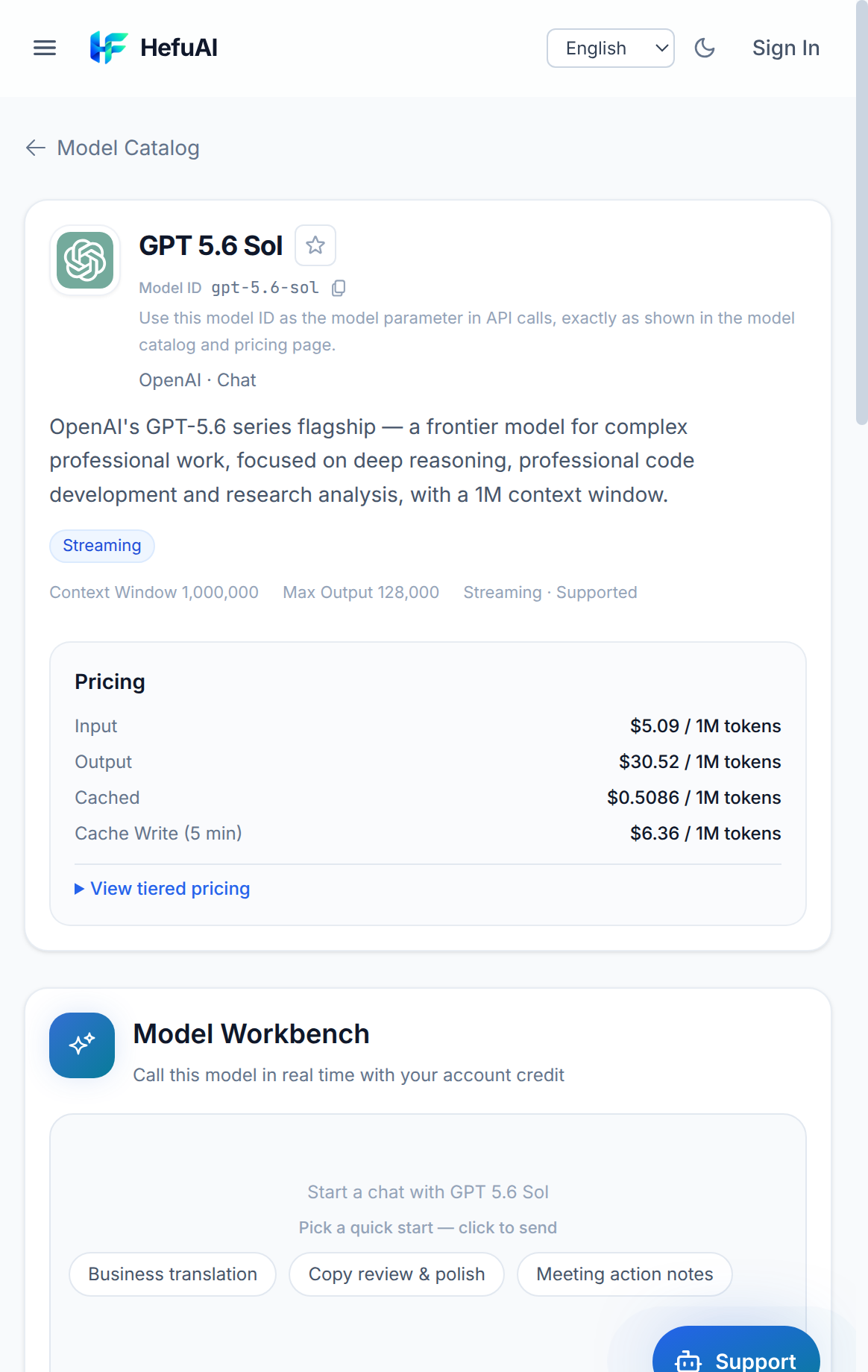
- Sol: $5.00 input / $30.00 output
- Terra: $2.00 input / $12.00 output
- Luna: $0.20 input / $1.20 output
OpenAI does not charge a fixed per-request fee for GPT-5.6; billing is purely token-based, with no separate charges disclosed for tool calls or image inputs in the official documentation as of Aug 2026. Two multipliers, however, can significantly alter your effective rate: cached reads (90% discount; e.g., Sol $0.50/M, Terra $0.20/M, Luna $0.02/M) and long-context surcharges (2x input / 1.5x output above 272K tokens). Cache writes are billed at 1.25x the base input rate (e.g., Sol $6.25/M, Terra $2.50/M, Luna $0.25/M). Always confirm the current rate sheet on the official pricing page before estimating production costs.
Model Variants and Their Price Tiers
GPT-5.6 shipped in a limited preview on Jun 26, 2026 and reached API general availability on Jul 9, 2026 (OpenRouter). The family spans three tiers:
- Sol ($5/$30): the flagship reasoning model. On Terminal-Bench 2.1, the GPT-5.6 Sol model scores 91.9% (Ultra) and 88.8% (base), outperforming prior-generation and competing flagship models (Eden AI; techjacksolutions).
- Terra ($2/$12): the balanced production tier, priced at 40% of the prior-generation flagship's rate ($5/$30) (Eden AI) — the sweet spot for most agentic and RAG workloads. Its post-cut price implies a 60% saving versus the prior-generation flagship on both input and output tokens.
- Luna ($0.20/$1.20): the high-throughput tier for classification, extraction, and bulk summarization where unit economics dominate. At 4% of the prior-generation flagship's per-token price (input and output), it is designed for workloads that tolerate lower reasoning depth.
For programming-specific workloads, the GPT-5.3 Codex model is also available through the same unified API gateway, complementing the GPT-5.6 family for code generation and repository-scale refactoring tasks.
Billing Mechanics: Token Counting and Batch Discounts
Token counting follows OpenAI's standard tokenizer, and invoices bill per 1,000 tokens even though prices are quoted per million. The mechanics that matter most:
- Cached reads: 90% discount — Sol cached input drops to $0.50/M (Spheron); Terra to $0.20/M; Luna to $0.02/M.
- Cache writes: 1.25x multiplier — Sol cache writes cost $6.25/M; Terra $2.50/M; Luna $0.25/M.
- Minimum cache lifetime: 30 minutes; shorter-lived cache entries may not qualify for the read discount.
- Long-context surcharge: inputs exceeding 272K tokens incur 2x input and 1.5x output fees (Spheron; eesel.ai). For Sol, this means effective rates of $10/M input and $45/M output on the overage portion.
As of Aug 2026, OpenAI has not published a separate batch-endpoint discount for GPT-5.6 on its official pricing page; batch terms, if any, should be verified with OpenAI sales or the official documentation.
Free Tier and Promotional Credits
OpenAI has not published a permanent free tier for GPT-5.6 as of Aug 2026. During the limited preview window (Jun 26 – Jul 9, 2026), selected developers received promotional usage credits, but these were time-boxed and tied to the preview program. New developers should check the OpenAI API page for current credit offers, which change frequently and are not guaranteed; as of this writing, no publicly documented free quota exists for the GPT-5.6 family — confirm availability on the official page.
Price Comparison: GPT-5.6 vs. Prior-Generation Flagship
| Model | Input ($/M tokens) | Output ($/M tokens) | Change vs. Prior Flagship | Notes |
|---|---|---|---|---|
| GPT-5.6 Sol | $5.00 | $30.00 | 0% (same as prior flagship) | Flagship; Terminal-Bench 2.1: 91.9% (Ultra) |
| GPT-5.6 Terra | $2.00 | $12.00 | -60% | Priced at 40% of prior flagship; pre-cut was $2.50/$15 |
| GPT-5.6 Luna | $0.20 | $1.20 | -96% vs. prior flagship; -80% vs. pre-cut $1/$6 | High-throughput tier |
| Prior-generation flagship (industry background) | $5.00 | $30.00 | Baseline | Superseded by GPT-5.6; not offered on this platform |
| Legacy tier (industry background) | ~$75.00 | ~$150.00 | Not comparable | Approximate 2024-era values; not offered on this platform |
Sources: OpenAI pricing; Layer3Labs; Eden AI. Prior-generation and legacy figures are approximate historical values and should be verified against archived OpenAI documentation.
The headline takeaway: OpenAI cut the cost of entry dramatically — Terra's price is now 40% of the prior-generation flagship's, Luna's is 4% of that baseline (an 80% cut from Luna's own pre-Jul 30 rate) — while Sol remains at flagship pricing. For developers who previously reserved flagship-tier models for critical paths only, Terra now makes production-grade reasoning affordable at scale.
Cost Optimization Strategies for Developers
- Route by task difficulty: Use Luna for high-volume extraction and classification, Terra for standard reasoning and RAG pipelines, and reserve Sol for the hardest agentic and coding tasks. This tiered routing alone can reduce spend by 60–96% compared to using Sol for every request (e.g., Terra input costs 60% less than Sol input; Luna input costs 96% less).
- Exploit prompt caching: With a 90% cached-read discount (Sol at $0.50/M, Terra at $0.20/M, Luna at $0.02/M), design prompts with a stable system prefix and cacheable context blocks. Keep the cache lifetime above 30 minutes to qualify for the discount.
- Compress prompts aggressively: Shorter inputs reduce both base input cost and the risk of crossing the 272K-token threshold, which triggers 2x input / 1.5x output surcharges (Spheron).
- Split long-context tasks: If a workflow regularly exceeds 272K tokens, decompose it into sub-calls rather than paying the surcharge; the break-even point favors splitting in most cases (e.g., a 300K-token input billed at Sol's rate costs $3.00 at the surcharged $10/M vs. $1.50 at the base $5/M if split below 272K).
- Buy through a unified gateway: For developers in mainland China, direct OpenAI access requires an overseas credit card and introduces network instability. Platforms like HeFu (an AI API aggregation platform) provide direct access to the full GPT-5.6 family (Terra / Sol / Luna) and GPT-5.3 Codex via a Hong Kong node, with no overseas credit card required — simplifying billing, routing, and compliance.
Enterprise Pricing and Custom Agreements
Enterprise terms for GPT-5.6 are negotiated per contract and are not published on the public pricing page. As of Aug 2026, OpenAI offers volume-based discounts, committed-use contracts, and dedicated capacity options for organizations processing large token volumes; the official page directs prospective enterprise customers to its sales team for custom agreements. Third-party relays show mixed pricing: OpenRouter lists GPT-5.6 Sol at the official $5/$30 rate, while One API and API2D rates were not verifiable in the available research materials as of Aug 2026 — request a written rate sheet before committing to any relay.
How to Verify Current Pricing
Prices change. The Jul 30, 2026 cut (Terra -20%, Luna -80%) demonstrates that OpenAI is actively repricing this family. Always consult the official OpenAI pricing page for real-time rates, and check the OpenRouter model page for relay pricing benchmarks. If purchasing through a reseller or gateway, request a dated rate sheet within the current month and confirm whether cache multipliers and long-context surcharges are passed through at official rates. On HeFu, the model detail pages for GPT-5.6 Sol, GPT-5.6 Terra and GPT-5.6 Luna show the same official rates plus tiered (>272K) pricing, so you can cross-check a quote in one visit.
FAQ
Q1: How do I choose between GPT-5.6 Sol, Terra, and Luna?
Choose Sol ($5/$30) when you need maximum reasoning accuracy — it scores 91.9% on Terminal-Bench 2.1 (Ultra) — for agentic coding, complex analysis, and high-stakes decision tasks. Choose Terra ($2/$12) for production workloads that need strong quality at 60% lower cost than the prior-generation flagship ($5/$30). Choose Luna ($0.20/$1.20) for bulk tasks like classification, summarization, and extraction where per-token cost dominates (96% cheaper than the prior-generation flagship). As of Aug 2026, this three-tier structure lets you match price to difficulty instead of paying flagship rates for every call.
Q2: Are relay services like OpenRouter cheaper than the official API?
As of Aug 2026, OpenRouter lists GPT-5.6 Sol at the official $5/$30 rate — no discount, but no markup either. One API and API2D rates were not verifiable in the available research materials, so compare any relay's stated price plus platform fees against the official rate sheet. For developers in mainland China, the deciding factor is often not the per-token price but the total cost of access: a gateway like HeFu with Hong Kong node direct connection and no overseas credit card requirement can be more economical once network stability and payment friction are factored in. HeFu passes through official rates on its model directory and offers pay-as-you-go billing with a built-in cost calculator.
Q3: How do prompt caching and long-context surcharges affect my bill?
Cached reads get a 90% discount (Sol drops from $5 to $0.50 per million input tokens), while cache writes cost 1.25x (Sol at $6.25/M). Inputs above 272K tokens trigger a 2x input and 1.5x output surcharge. Concretely, for a request on the Sol tier with 300K input tokens and 100K output tokens, the surcharged effective rates are $10/M input and $45/M output, yielding a total of $3.00 + $4.50 = $7.50; the same request under 272K tokens would cost $1.50 + $3.00 = $4.50. Keep contexts under 272K or cache aggressively to avoid the surcharge.
Q4: Are there any hidden fees with GPT-5.6 API?
No fixed per-request fees are disclosed in the official documentation as of Aug 2026. The only additional charges are the cache-write multiplier (1.25x) and long-context surcharges (2x input / 1.5x output) described above. If buying through a gateway or relay, confirm whether the quoted rate is all-inclusive or subject to a platform margin, and whether the 90% cached-read discount is passed through to you.
FAQ
How do I choose between GPT-5.6 Sol, Terra, and Luna?
Choose Sol ($5/$30) when you need maximum reasoning accuracy — it scores 91.9% on Terminal-Bench 2.1 (Ultra) — for agentic coding, complex analysis, and high-stakes decision tasks. Choose Terra ($2/$12) for production workloads that need strong quality at 60% lower cost than the prior-generation flagship ($5/$30). Choose Luna ($0.20/$1.20) for bulk tasks like classification, summarization, and extraction where per-token cost dominates (96% cheaper than the prior-generation flagship). As of Aug 2026, this three-tier structure lets you match price to difficulty instead of paying flagship rates for every call.
Are relay services like OpenRouter cheaper than the official API?
As of Aug 2026, OpenRouter lists GPT-5.6 Sol at the official $5/$30 rate — no discount, but no markup either. One API and API2D rates were not verifiable in the available research materials, so compare any relay's stated price plus platform fees against the official rate sheet. For developers in mainland China, the deciding factor is often not the per-token price but the total cost of access: a gateway like HeFu with Hong Kong node direct connection and no overseas credit card requirement can be more economical once network stability and payment friction are factored in. HeFu passes through official rates on its [model directory](https://hefu.hk/models) and offers pay-as-you-go billing with a built-in [cost calculator](https://hefu.hk/calculator).
How do prompt caching and long-context surcharges affect my bill?
Cached reads get a 90% discount (Sol drops from $5 to $0.50 per million input tokens), while cache writes cost 1.25x (Sol at $6.25/M). Inputs above 272K tokens trigger a 2x input and 1.5x output surcharge. Concretely, for a request on the Sol tier with 300K input tokens and 100K output tokens, the surcharged effective rates are $10/M input and $45/M output, yielding a total of $3.00 + $4.50 = $7.50; the same request under 272K tokens would cost $1.50 + $3.00 = $4.50. Keep contexts under 272K or cache aggressively to avoid the surcharge.
Are there any hidden fees with GPT-5.6 API?
No fixed per-request fees are disclosed in the official documentation as of Aug 2026. The only additional charges are the cache-write multiplier (1.25x) and long-context surcharges (2x input / 1.5x output) described above. If buying through a gateway or relay, confirm whether the quoted rate is all-inclusive or subject to a platform margin, and whether the 90% cached-read discount is passed through to you.